Blog → Choosing a Restaurant for a Business Dinner
How to Choose a Restaurant for a Business Dinner
By DarfarMenu Editorial Team · Industry Analyst · Former restaurant operator
Published July 26, 2026
The pitch was ready. The relationship was warm. And then the four of you sat down at a long rectangular table in a converted warehouse with exposed brick, a live DJ, and a ceiling that bounced every sound in the room straight back down. The person at the far end heard maybe a third of the conversation. Nobody said anything about it, and nobody followed up either.
That dinner cost somewhere north of $600, plus flights, plus a night that three busy people will never get back. The food may have been excellent. It did not matter. A business dinner has exactly one job — to let people talk easily for two hours — and the restaurant either does that job or quietly sabotages it.
What makes this maddening is that the failure is entirely preventable and almost never about cuisine. The venue variables that decide whether a business dinner works are boring, measurable, and easy to check in advance. Here is the framework, in the order that actually matters.
Start by Naming the Dinner
Before you open a reservation app, decide which of four dinners you are hosting. Each one points to a different room.
- The relationship dinner. No agenda beyond staying close to a good client. Comfort, familiarity, and a room where the conversation can wander. Neighborhood favorites beat trophy restaurants here.
- The deal dinner. Real business gets discussed. You need quiet, privacy, and a table where documents or a phone screen can come out without theater.
- The recruiting dinner. You are selling a company and a city. A restaurant with a sense of place does more work than a chain steakhouse, and the candidate should leave with a story.
- The celebration dinner. Energy is a feature, not a bug. A livelier room is fine, but you still need to be able to make a toast that people can hear.
Name the dinner and half the shortlist eliminates itself. The deal dinner and the celebration dinner want opposite rooms, and most bad venue picks come from choosing one when you needed the other.
Noise Is the Variable That Decides Everything
Here is the number worth memorizing: normal conversation happens around 60 decibels. At 70 dB you are raising your voice. At 75 to 80 dB — which is where a busy modern restaurant with hard surfaces sits on a Thursday at 8 p.m. — sustained conversation across a table of four becomes genuinely difficult, and anyone with even mild hearing loss is effectively excluded.
Restaurant noise has climbed steadily for two decades because hard surfaces are cheaper, energy reads as popularity, and loud rooms turn tables faster. None of those incentives are on your side tonight.
How to check before you commit:
- Read reviews for the word acoustics. Search the restaurant name with terms like loud, noisy, or hard to hear. Diners complain about this reliably and specifically.
- Look at photos of the ceiling and floor. Exposed concrete, brick, glass, and bare wood mean a live room. Carpet, drapery, upholstered banquettes, and acoustic panels mean a quiet one.
- Visit or call at the same hour you plan to dine. A phone call at 8 p.m. tells you a lot: if the host is shouting over the background, so will you.
- Ask directly. Ask the reservationist which section is quietest and whether there is live music that night. They will tell you.
If you need a shortcut, the quietest tables in almost any restaurant are the corner banquettes and the seats furthest from the bar, the open kitchen, and the service station. Ask for one by name.
Table Shape and Room Geometry
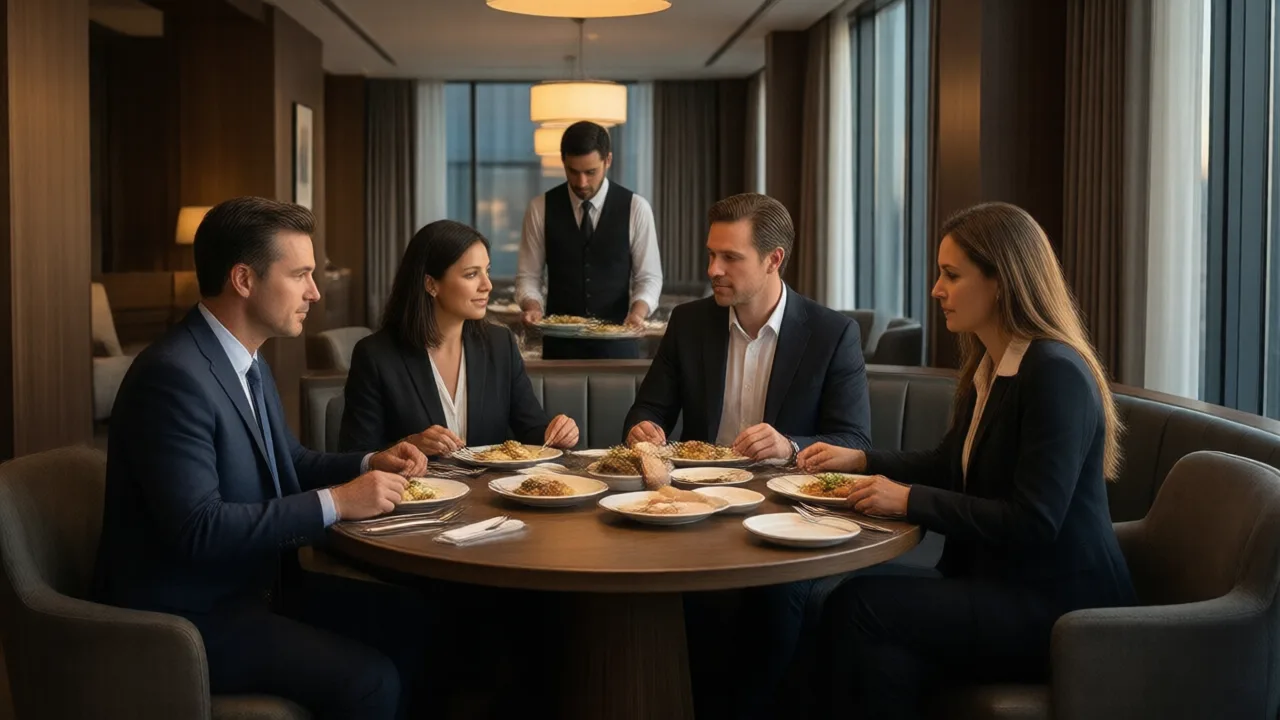
A round table for four to six is the single best piece of business dinner furniture ever built. Everyone can see everyone, the conversation stays one conversation, and no one is stranded at an end. A long rectangle of six or more inevitably splits into two or three separate conversations, which is exactly what you did not fly in for.
Above eight people, geometry stops working and you need a room. Private dining rooms typically carry a food and beverage minimum rather than a rental fee — commonly $500 to $1,500 on a weeknight in a mid-market city, and $2,000 to $5,000 for a prime Friday in a major one. That minimum counts everything except tax and gratuity, and most groups clear it without trying.
Private rooms are also a real revenue line for restaurants, not a favor, which is why the good ones have a dedicated coordinator, contracts, and set menus. Understanding how restaurants structure private dining and event business makes you a better negotiator: ask about minimums by day of week, whether an off-peak slot lowers it, and what happens to the balance if you fall short.
The Menu Has to Cover Everyone
You will rarely know your guests’ dietary needs in advance, and asking a senior client to list their restrictions is awkward. Solve it structurally by choosing a menu with breadth: at least one strong vegetarian entree, a fish option, a red-meat option, and something that can go gluten-free without a negotiation.
This is why a hyper-specialized restaurant — an all-raw-bar spot, a whole-hog barbecue joint, a tasting-menu-only room — is a gamble for a first dinner with someone you do not know well. Save it for the second dinner, once you know what they eat. If someone does flag a restriction, our practical guide to eating out with dietary restrictions covers how to brief a kitchen without turning the meal into a production.
One more thing that quietly matters: shareable items. A few things in the middle of the table — a seafood tower, a board, sides family-style — give people something to do with their hands and a natural bridge into conversation. Rooms where everyone eats a plated solo entree in silence feel more like a deposition.
Logistics That Guests Notice Without Naming
Distance from their hotel, not yours
Keep it under a 15-minute ride from where your guest is staying. Every extra mile is time they spend in traffic thinking about their next flight.
Parking or a clean drop-off
Valet, a garage within a block, or an easy rideshare curb. A guest circling for street parking starts the evening annoyed.
A reservation time that respects the flight
7:00 or 7:30 p.m. is the sweet spot. Later than 8:00 punishes anyone on East Coast time; earlier than 6:30 fights rush hour.
A two-hour table, honestly assessed
Ask whether the table is yours for the evening or whether there is a second seating. Being asked to leave mid-conversation undoes an otherwise perfect dinner.
A dress code that matches the invite
Tell your guest what to expect. A jacket-required room is a bad surprise for someone who packed for a warehouse district.
Service Quality Is a Selection Criterion, Not Luck
A well-run dining room protects your dinner in ways you never see: courses paced so nobody is mid-sentence when a plate lands, water refilled without interruption, plates cleared only when everyone has finished, and a server who reads the table instead of performing at it. That discipline is trained, and the restaurants that invest in it are consistent about it — the specifics of what trained service standards look like in practice are a useful checklist when you are evaluating a room you have not tried.
The fastest way to assess it before booking: call rather than book online. In 90 seconds you learn whether the phone is answered warmly, whether they can describe the quiet sections, and whether they offer to note the occasion. A restaurant that handles a phone call well almost always handles a table well.
If you are hunting for a new go-to rather than defaulting to the obvious steakhouse, the same instincts that surface genuinely good under-the-radar restaurants work here — with the added filters of noise and table shape applied first.
Wine Without the Performance
Two rules keep the wine portion of a business dinner from becoming a status test. First, offer a bottle for the table and let your guest weigh in on the style rather than the price. Second, choose in the $60 to $90 range at a normal restaurant, where the quality curve is steepest relative to markup, and let the sommelier do the work: name the range out loud, name the style, and let them bring options.
If the list is long and unfamiliar, a couple of minutes with a primer on reading a wine list is worth more than any memorized producer name. And if anyone at the table is not drinking, order sparkling water for the table at the same time so nobody is the only person without a glass.
The Bill Should Be Invisible
The moment the leather folder lands between you and your guest, the dinner briefly becomes about money. Avoid it entirely: hand your card to the host when you arrive and ask them to close the check without bringing it to the table, or call ahead and set up payment with the manager. Restaurants do this every night and it takes ten seconds to arrange.
Tip 20 to 22 percent, and go higher if you held the table long, made special requests, or used a private room where a captain worked your party all night. For groups of six or more, check whether a service charge has already been added so you do not double-tip by accident — our current tipping etiquette guide lays out where the norms have landed.
Red Flags Worth Walking Away From
- No published menu online. You cannot plan around dietary needs or budget, and you cannot brief your guest.
- Recent reviews mentioning noise or slow service. Two or more in the last three months is a pattern, not a bad night.
- A reservation only available at 5:30 or 9:30. Those seatings are turn slots. You will feel the clock.
- The restaurant opened in the last four weeks. Let someone else beta-test the service. A brand-new kitchen is a poor place to put a client.
- Communal seating or bar-only. Fun for friends, wrong for anything that involves a conversation you would not want overheard.
Vetting a restaurant before you book the table?
Check live menus, prices, and options from local restaurants
The Working Checklist
Name the dinner. Screen for noise before cuisine. Request a round table or a corner banquette. Confirm the menu covers a vegetarian, a fish, and a gluten-free path. Book two to three weeks out for prime time, four to six for a private room. Keep it within fifteen minutes of your guest’s hotel. Set up payment on arrival. Do that much and the restaurant disappears into the background — which, for a business dinner, is the highest compliment a room can earn.
Frequently Asked Questions
How much should you budget per person for a business dinner?
Plan on $75 to $125 per person for a standard client dinner in most U.S. cities, and $150 to $250 in a top steakhouse or a major market like New York or San Francisco. That range assumes an appetizer, an entree, shared sides, one or two drinks, tax, and a 20 percent tip. Set the number before you pick the restaurant, not after.
What is the best table to request for a business dinner?
Ask for a round table or a corner banquette away from the kitchen door, the bar, and any speaker. A round table of four to six lets everyone hear everyone, which a long rectangle does not. Request it when you book and confirm again the morning of, since table assignments are usually set a few hours before service.
How far in advance should you book a business dinner?
Book two to three weeks ahead for a prime-time weeknight table at a well-known restaurant, and four to six weeks if you need a private room or a party larger than eight. For groups over twelve, most restaurants require a signed event agreement and a food and beverage minimum, which takes longer to arrange than a standard reservation.
Should you order alcohol at a business dinner?
Follow your guest's lead and keep it to one or two drinks. If the client orders wine, joining them is gracious; if they decline, order sparkling water without comment. The safest move as a host is to offer a bottle for the table and let the guest decide, which keeps the choice with them and avoids putting anyone on the spot.
How do you pay the bill discreetly at a business dinner?
Give the restaurant your card when you arrive, or arrange payment with the manager beforehand, and ask that the check never come to the table. Most restaurants do this routinely for host accounts. If you did not set it up in advance, excuse yourself near the end of dessert and settle the bill at the host stand rather than reaching for the folder in front of your guest.